Industrial Powder Coating Oven Sizing: A Production Engineer's Guide
How to size a commercial or industrial powder coating oven for production throughput: internal volume, thermal mass, cure time, heating capacity, and airflow. A working reference for plant engineers.
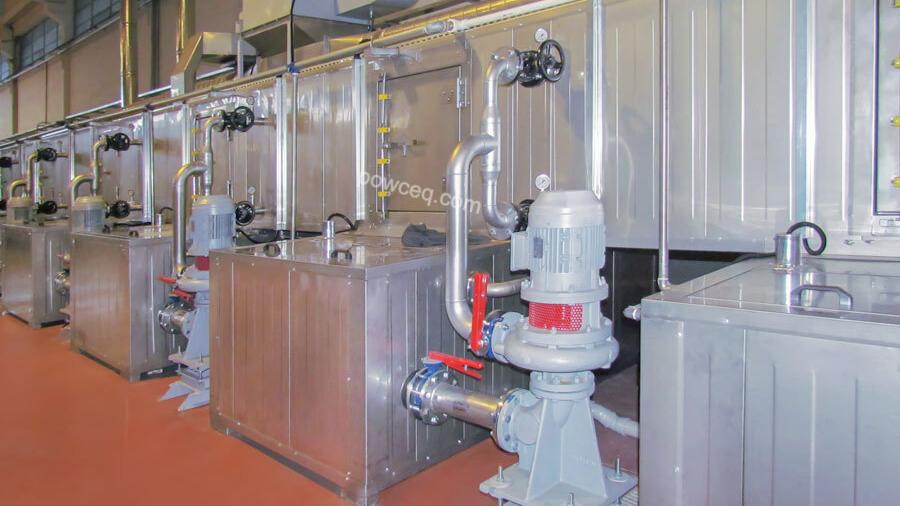
Specifying an industrial powder coating oven for production is a sequence of four decisions, each of which constrains the next: internal volume, heat source, airflow pattern, and cure time window. Get the first one wrong and no amount of burner tuning will fix it. This guide is the working reference we use when scoping commercial and industrial ovens for customers: batch ovens for job shops up to conveyorized cure tunnels on automated lines.
Before we start: this is specifically about production-grade industrial ovens. DIY ovens for hobby refinishing are a different category entirely: not engineered for duty cycles, regulatory compliance, or process repeatability, and out of scope here. If you're coating parts for sale, you need industrial equipment.
Step 1: Size the internal volume to your part envelope
Every oven specification starts from a single physical question: what's the largest part envelope you need to cure, plus clearance for hanging, conveyor hooks, and airflow? Volume sizing cascades from there.
The working formula for a batch oven is:
Internal volume = Part envelope × 1.4 (airflow + clearance) + Conveyor/rack volume
A part envelope of 2 m × 1 m × 1 m (2 m³) needs an oven sized around 3.0-3.5 m³ internal minimum: 2 m³ parts plus 1.0 m³ for airflow, rack, and thermal recirculation. Undersize this and you'll get cold spots near walls; oversize it and you burn energy heating empty volume.
For a conveyorized cure oven, the math is different:
Oven length = (Line speed × Cure time) + Transition allowance (1.5-2 m)
A line running at 2 m/min with 20-minute cure time needs an oven interior 41.5 meters long (40 m of cure + 1.5 m entry/exit). Cut the cure time to 10 minutes and the oven shrinks to 21.5 m. This is why low-cure powder chemistries can be economically transformative: every minute of cure time removed shrinks the oven by two meters at typical line speeds.
Step 2: Heat source: electric, gas, or hybrid
Heat source selection cascades from oven volume, energy costs, and regulatory environment. Our gas vs electric curing ovens guide covers the full operating-cost math. Summary:
Electric ovens
Win below ~20 m³ internal volume. Cleaner installation: no combustion air, no flue, no gas train. No combustion byproducts touching parts (relevant for some food-contact and medical-equipment powders). Capital cost is lower at small sizes, higher at large sizes. Peak heating load for a mid-size electric oven runs 30-80 kW; a large production oven runs 100-250 kW.
Gas-fired ovens
Win above ~20 m³ internal volume, and win decisively above 40 m³. Lower operating cost per m³ in most markets (except where electricity is unusually cheap or gas is unusually expensive). Faster warm-up for modulating burner designs. Require site gas supply, flue routing, and compliance with combustion regulations.
Infrared booster + convection hybrid
For high-throughput lines (3+ m/min) or low-mass parts where convection-only cure is slow, an infrared pre-heat zone at the oven entry brings powder up to gel temperature in seconds, then convection finishes the cure. Adds 10-20% to oven capital cost; cuts cure time by 30-50%. Right answer for architectural aluminium profiles and thin sheet metal.
Step 3: Airflow pattern
Heating the air is only useful if the air reaches the part. Airflow design determines whether a correctly-specified heat source translates into correctly-cured parts.
Three airflow patterns dominate commercial ovens:
Horizontal recirculation
Air blown horizontally across the part from supply ducts high on one wall, returning on the opposite side. Works well for uniform parts, simple geometries, and conveyor systems where parts present consistently. Standard configuration for architectural aluminium profile ovens.
Vertical top-down
Air supplied from roof plenums, extracted at floor level. Best for parts with significant vertical dimension: tall racks, hanging assemblies, and structural steel. Harder to tune but produces very uniform cure on complex vertical stacks.
Mixed / zone-specific
Multi-zone ovens use different airflow patterns in different zones: horizontal recirculation in the cure zone, vertical in the ramp zone, turbulent mixing at entry. Adds complexity and CapEx; used only on Tier 3 lines where single-pattern cure can't meet spec.
For most production ovens below 30 m³, horizontal recirculation at 0.8-1.5 m/s air velocity is the right default. Higher velocities consume more fan power without meaningful cure benefit; lower velocities leave cold spots in corners.
Step 4: Cure time window
Powder manufacturers publish cure schedules as part-temperature-time triplets: "20 minutes at 200 °C PMT" means 20 minutes at part metal temperature of 200°C, not 20 minutes in the oven at 200°C setpoint. The distinction matters because heavy parts take 10-15 minutes to come up to temperature, so an oven cycle of 20 minutes at 200°C setpoint may deliver only 5 minutes of cure at PMT.
The production cure cycle therefore has three phases:
- Ramp up: part enters oven at ambient, climbs to cure temperature. Duration depends on part thermal mass and oven airflow. Typical 5-15 minutes.
- Cure dwell: part at PMT ≥ specified temperature, for specified duration. Typical 10-20 minutes.
- Ramp down or cooling: for low-distortion applications, a controlled cool-down extends cycle time by 5-15 minutes but prevents warping on thin aluminium.
On a conveyorized line, the oven length reserves time for the full cycle. On a batch oven, the operator holds the door closed for the full cycle plus a safety margin. Either way, the oven must be sized to the slowest-to-heat part in production, not the fastest.
Common sizing mistakes
- Sizing to current production instead of 3-year production. Ovens are sticky capital: you'll operate this one for 15+ years. If production is growing 20% annually, size for 3-year forward throughput, not day-one.
- Undersizing heating on gas ovens for cold-start recovery. Steady-state heating load is 40-60% of peak. Size the burner to the peak, not the steady-state, or your Monday-morning cold-start takes 3 hours.
- Single-zone ovens for multi-powder production. If you run high-gloss polyester and TGIC architectural powder through the same oven, either run two separate cycles or install a two-zone oven with independent temperature setpoints. Mixing cure curves degrades finish quality on both.
- Skipping heat recovery on gas ovens above 40 m³. Exhaust recirculation or air-to-air heat exchangers cut operating cost 15-30%. Payback is 18-36 months at European gas prices, 30-60 months in the GCC.
Next steps
If you're specifying an industrial or commercial powder coating oven and want sizing grounded in real production math: throughput targets, part envelope, cure schedule, and local energy costs, the fastest path is to send us your production data and we'll come back with an oven configuration and CapEx/OpEx model within one business day.
PowCEQ supplies oven equipment as part of complete automated powder coating lines and as standalone batch or continuous curing systems. For deeper technical reading, see our guides on gas vs electric economics and pretreatment sizing.
Related articles
Corona vs Tribo: How to Choose an Electrostatic Powder Coating Gun
The two fundamental technologies in powder coating spray guns: corona (high-voltage ionization) and tribo (friction charging). When each wins, where each fails, and how production shops choose between them.
Low-Cure MDF Powder Coating: Process Spec for Furniture Makers
Low-cure powder chemistry, preheat strategy, dielectric substrate handling, and line configuration for powder coating MDF and engineered wood. The complete process spec for furniture and cabinet manufacturers.
Gas vs Electric Curing Ovens: Real Operating Cost at Scale
Up-front capital, recovery time, cycle cost, and crossover thresholds for gas-fired and electric powder coating ovens. The math behind the right heat source for your production volume.
Need expert input on your project?
Our engineering team has delivered powder coating systems across 40+ countries. Tell us about your application.