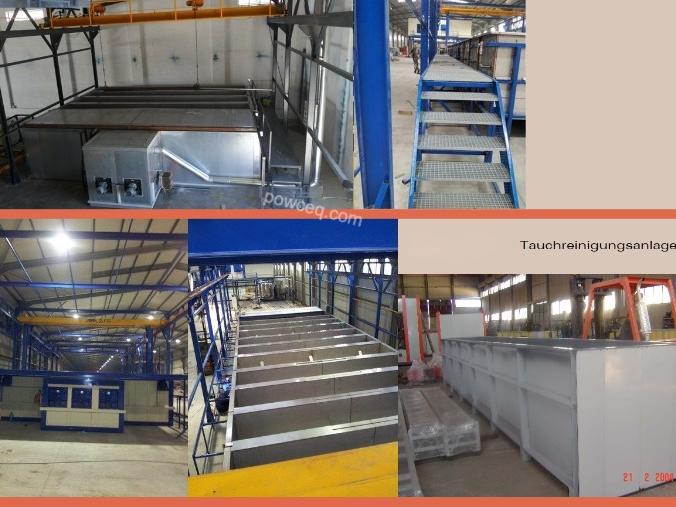
Dip Tank Pretreatment System
For batch operations: multi-stage immersion cleaning before coating
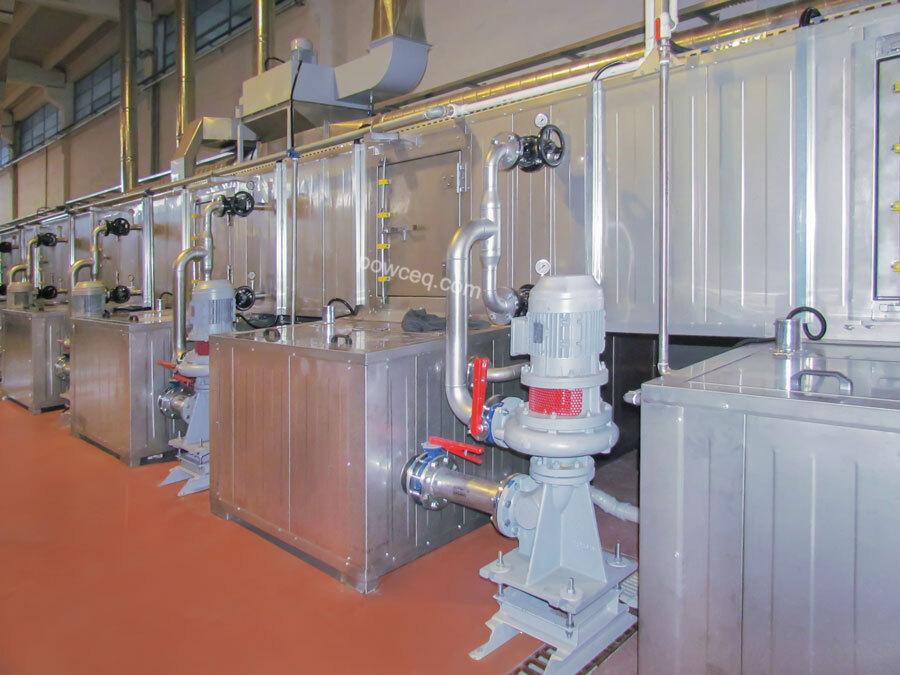
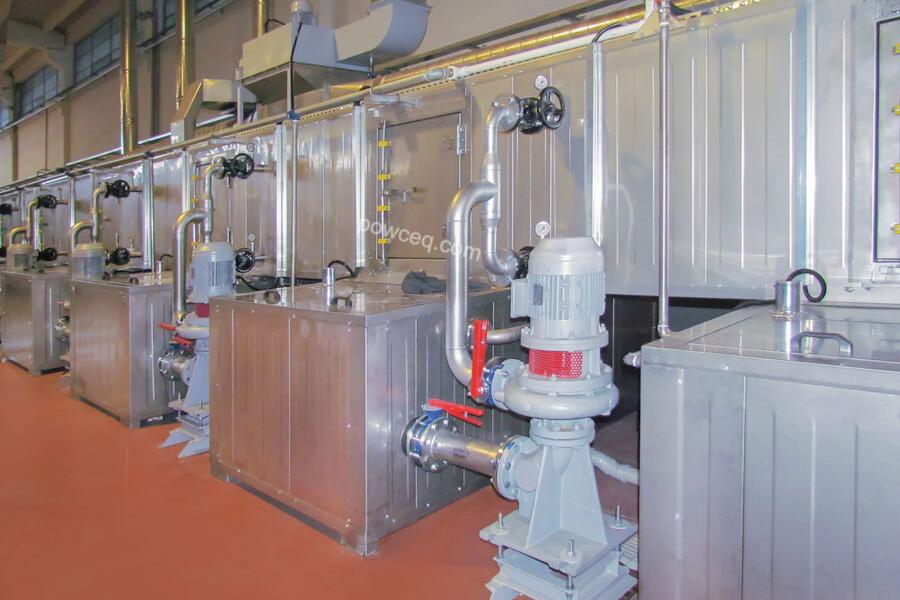
The Dip Tank Pretreatment System is an immersion pretreatment line that prepares parts for powder coating by submerging them through a series of chemical and rinse tanks. Pretreatment is the step that decides whether your coating actually lasts: clean, properly converted metal gives the powder something to bond to and resists corrosion under the film, while a poor surface fails no matter how good the application. The dip tank approach handles parts in batches on racks, lowering them fully into each tank so every surface, including recesses and internal areas that spray can miss, gets complete chemical contact.
Multi-stage immersion process
The system is configurable from 3 to 8 or more stages, so you build the process your parts and substrates require. A typical sequence runs through degrease, rinse, conversion coating, and rinse, with stage count rising as you add cleaning or rinse steps for heavier soils or tighter quality targets. Immersion is the key advantage for complex geometry: because parts are fully submerged, the chemistry reaches every surface evenly, which is hard to guarantee with spray on boxed sections, tubes, or deeply recessed parts. You scale the stage count to the contamination you are removing and the conversion performance you need.
Chemistry options
The line supports phosphate, nano, and chrome-free chemistries, including Oxsilane and Bonderite systems, so you can match the conversion coating to your substrate and your corrosion and environmental requirements. Traditional phosphate remains a proven baseline, while nano and chrome-free options like Oxsilane reduce environmental load and suit shops moving away from chrome and heavy phosphate. Because the chemistry is selectable, the same tank line can be specified for a conservative phosphate process or a modern chrome-free one depending on the parts and the standard you are coating to.
Materials handled
The system handles a wide range of substrates: black steel, carbon steel, aluminum profiles, galvanized parts, and cast iron, processed in batches on racks. That breadth makes it suitable for a mixed-substrate shop where one day is steel fabrications and the next is aluminum profile. Different metals need different conversion chemistry to perform, which is why the selectable chemistry and the configurable stage count work together: you set up the process for the substrate in front of you. For architectural aluminium specifically, our guide on pretreatment sizing for architectural aluminium covers how to match stage count and chemistry to the durability class you are targeting.
Tank sizing and automation
Tanks are custom sized to your parts, so the system is built around your largest and most awkward workpieces rather than forcing you to cut parts down to fit. For heavier throughput, crane automation is available to move racks through the tank sequence on a controlled cycle, which improves consistency of immersion and dwell time and takes the manual handling out of moving loaded racks between stages. You specify tank dimensions and decide whether to run manual or crane-assisted based on part size, weight, and volume.
Where it fits in your line
The Dip Tank Pretreatment System sits at the front of the coating line, upstream of the powder booth and curing oven, as the surface-preparation stage that everything downstream depends on. Racked parts pass through the immersion sequence, then move to drying and on to the powder coating booth and spray guns before curing. It is the best fit where part geometry is complex or batches are mixed, since full immersion reaches surfaces that spray cannot, giving the powder a clean, well-converted base to bond to. For continuous high-volume work on simpler parts, a continuous spray wash line is the alternative; for batch work and difficult shapes, the dip tank is the stronger choice.
Price on request
Contact to place order
Specifications
- Type
- Immersion / dip tank
- Stages
- 3-8+ configurable
- Materials
- Steel, aluminum, galvanized
- Chemistry
- Phosphate / nano / chrome-free
Key Features
- Multi-stage immersion process
- Degreasing and phosphating
- Chrome-free options available
- Nanotechnology (Oxsilane, Bonderite)
- Custom tank sizing
- Crane automation available
Applications
Ready to discuss your project?
Contact our engineering team with your requirements. We respond within 1 business day.